Services

Industries

Company

Common Flange Types and Where They’re Used

Common Flange Types and Where They’re Used

(01)

Flanges are essential components in industrial piping systems, allowing pipes, valves, pumps, and equipment to connect securely while remaining serviceable for inspection, maintenance, or replacement. Selecting the right flange type improves safety, reduces leakage risk, and ensures long-term reliability across oil & gas, petrochemical, power, and process industries.

A close up of pipes and pipes in front of a tree

Why Flanges Matter in Industrial Piping

Flanges create a strong, sealed, and standardized connection between piping components. They make it possible to assemble complex systems, isolate sections for shutdown work, and remove equipment without cutting or permanently modifying the line. Because flange joints can experience pressure, temperature cycling, vibration, and corrosion, flange selection must match the operating conditions and maintenance needs of the plant.

In industrial projects, the flange type often depends on pressure rating, temperature, pipe size, material, and the practicality of welding. Some flanges are selected for strength in critical services, while others prioritize ease of installation, cost efficiency, or repeated disassembly.

Why Flanges Matter in Industrial Piping

Flanges create a strong, sealed, and standardized connection between piping components. They make it possible to assemble complex systems, isolate sections for shutdown work, and remove equipment without cutting or permanently modifying the line. Because flange joints can experience pressure, temperature cycling, vibration, and corrosion, flange selection must match the operating conditions and maintenance needs of the plant.

In industrial projects, the flange type often depends on pressure rating, temperature, pipe size, material, and the practicality of welding. Some flanges are selected for strength in critical services, while others prioritize ease of installation, cost efficiency, or repeated disassembly.

Why Flanges Matter in Industrial Piping

Flanges create a strong, sealed, and standardized connection between piping components. They make it possible to assemble complex systems, isolate sections for shutdown work, and remove equipment without cutting or permanently modifying the line. Because flange joints can experience pressure, temperature cycling, vibration, and corrosion, flange selection must match the operating conditions and maintenance needs of the plant.

In industrial projects, the flange type often depends on pressure rating, temperature, pipe size, material, and the practicality of welding. Some flanges are selected for strength in critical services, while others prioritize ease of installation, cost efficiency, or repeated disassembly.

High-Strength Flanges for Critical Service

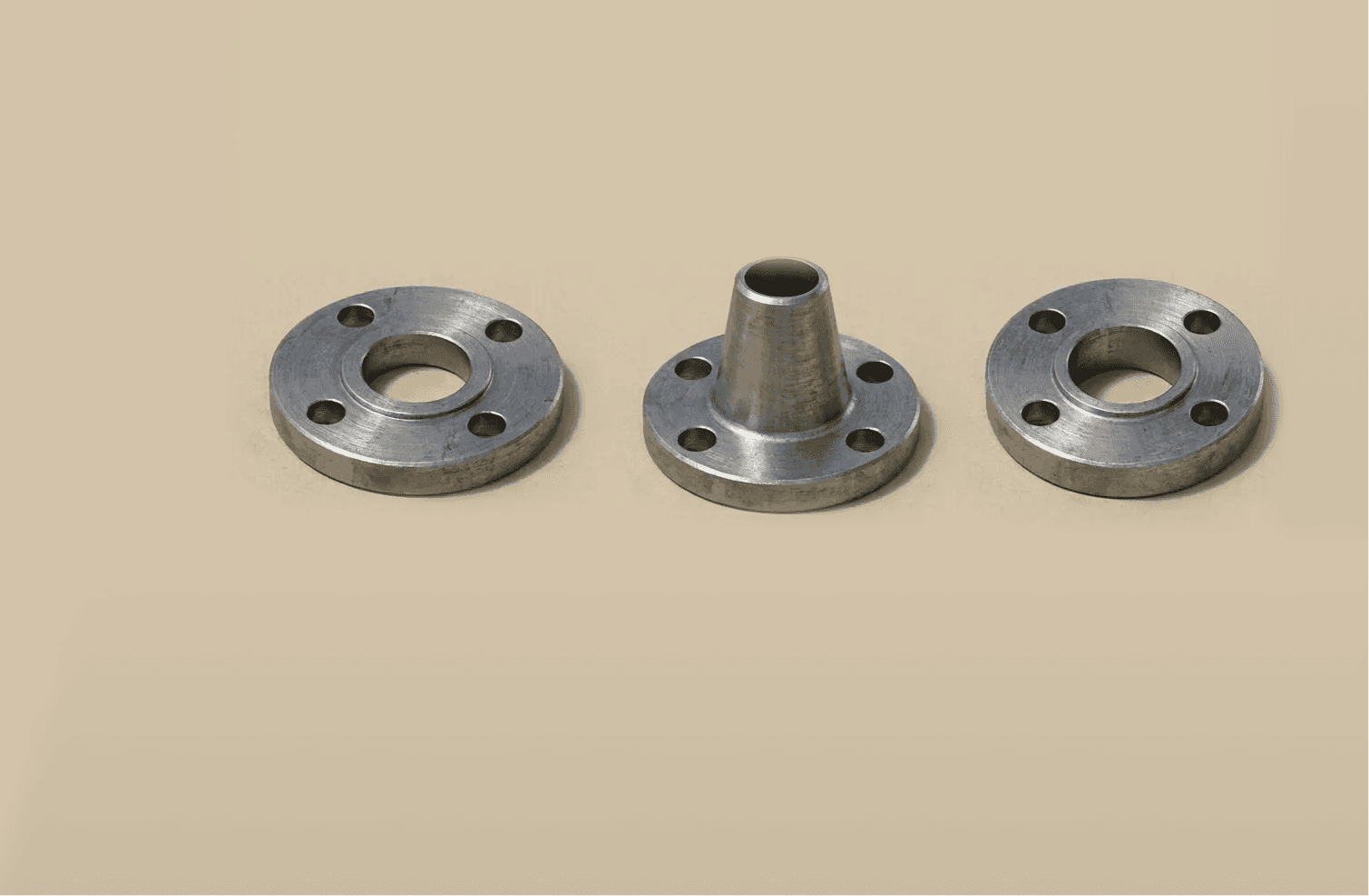
Weld Neck Flange (WN) is designed with a long tapered neck that distributes stress smoothly from the flange to the pipe. This design reduces fatigue and improves performance in high-pressure and high-temperature applications. Weld neck flanges are widely used in oil & gas, chemical processing, and power plants where joint integrity is critical.

Ring-Type Joint Flange (RTJ) is engineered for extreme service where leakage control is crucial. It uses a machined groove and a metallic ring gasket to achieve a high-integrity seal. RTJ flanges are common in refineries, high-pressure pipelines, and power systems where conventional gasket sealing may not be sufficient.

High-Strength Flanges for Critical Service

Weld Neck Flange (WN) is designed with a long tapered neck that distributes stress smoothly from the flange to the pipe. This design reduces fatigue and improves performance in high-pressure and high-temperature applications. Weld neck flanges are widely used in oil & gas, chemical processing, and power plants where joint integrity is critical.

Ring-Type Joint Flange (RTJ) is engineered for extreme service where leakage control is crucial. It uses a machined groove and a metallic ring gasket to achieve a high-integrity seal. RTJ flanges are common in refineries, high-pressure pipelines, and power systems where conventional gasket sealing may not be sufficient.

High-Strength Flanges for Critical Service

Weld Neck Flange (WN) is designed with a long tapered neck that distributes stress smoothly from the flange to the pipe. This design reduces fatigue and improves performance in high-pressure and high-temperature applications. Weld neck flanges are widely used in oil & gas, chemical processing, and power plants where joint integrity is critical.

Ring-Type Joint Flange (RTJ) is engineered for extreme service where leakage control is crucial. It uses a machined groove and a metallic ring gasket to achieve a high-integrity seal. RTJ flanges are common in refineries, high-pressure pipelines, and power systems where conventional gasket sealing may not be sufficient.

Installation-Friendly Flanges for General Service

Slip-On Flange (SO) slides over the pipe and is welded both on the inside and outside. It is faster and easier to install than a weld neck flange, making it a popular choice for low-pressure, moderate-temperature systems. Slip-on flanges are frequently used in utilities, HVAC, water lines, and non-critical industrial services.

Socket Weld Flange (SW) includes a socket recess where the pipe is inserted before welding. This configuration provides strong support and a leak-resistant joint, especially in small-diameter piping where high pressure is involved. Socket weld flanges are common in hydraulic systems, chemical lines, and gas services requiring compact yet robust connections.

Installation-Friendly Flanges for General Service

Slip-On Flange (SO) slides over the pipe and is welded both on the inside and outside. It is faster and easier to install than a weld neck flange, making it a popular choice for low-pressure, moderate-temperature systems. Slip-on flanges are frequently used in utilities, HVAC, water lines, and non-critical industrial services.

Socket Weld Flange (SW) includes a socket recess where the pipe is inserted before welding. This configuration provides strong support and a leak-resistant joint, especially in small-diameter piping where high pressure is involved. Socket weld flanges are common in hydraulic systems, chemical lines, and gas services requiring compact yet robust connections.

Installation-Friendly Flanges for General Service

Slip-On Flange (SO) slides over the pipe and is welded both on the inside and outside. It is faster and easier to install than a weld neck flange, making it a popular choice for low-pressure, moderate-temperature systems. Slip-on flanges are frequently used in utilities, HVAC, water lines, and non-critical industrial services.

Socket Weld Flange (SW) includes a socket recess where the pipe is inserted before welding. This configuration provides strong support and a leak-resistant joint, especially in small-diameter piping where high pressure is involved. Socket weld flanges are common in hydraulic systems, chemical lines, and gas services requiring compact yet robust connections.

Flanges Designed for Easy Maintenance and Disassembly

Blind Flange (BL) has no bore and is used to close the end of a pipe, valve, or pressure vessel opening. It is widely used during maintenance, hydrotesting, and future tie-in planning, and it can be applied across both high- and low-pressure systems depending on the rating and design.

Threaded Flange (TH) uses internal threads to screw onto threaded pipe. It is useful in situations where welding is not allowed or not practical, such as in hazardous environments or temporary piping. Threaded flanges are generally used for lower-pressure applications and smaller pipe sizes, including certain oil, gas, and water services.

Lap Joint Flange (LJ) consists of a loose backing flange paired with a stub end. This design allows easy rotation and alignment during installation and simplifies disassembly later. Lap joint flanges are often used where frequent dismantling is expected or where corrosion-resistant stub ends are required, making them common in chemical and marine environments.

Flanges Designed for Easy Maintenance and Disassembly

Blind Flange (BL) has no bore and is used to close the end of a pipe, valve, or pressure vessel opening. It is widely used during maintenance, hydrotesting, and future tie-in planning, and it can be applied across both high- and low-pressure systems depending on the rating and design.

Threaded Flange (TH) uses internal threads to screw onto threaded pipe. It is useful in situations where welding is not allowed or not practical, such as in hazardous environments or temporary piping. Threaded flanges are generally used for lower-pressure applications and smaller pipe sizes, including certain oil, gas, and water services.

Lap Joint Flange (LJ) consists of a loose backing flange paired with a stub end. This design allows easy rotation and alignment during installation and simplifies disassembly later. Lap joint flanges are often used where frequent dismantling is expected or where corrosion-resistant stub ends are required, making them common in chemical and marine environments.

Flanges Designed for Easy Maintenance and Disassembly

Blind Flange (BL) has no bore and is used to close the end of a pipe, valve, or pressure vessel opening. It is widely used during maintenance, hydrotesting, and future tie-in planning, and it can be applied across both high- and low-pressure systems depending on the rating and design.

Threaded Flange (TH) uses internal threads to screw onto threaded pipe. It is useful in situations where welding is not allowed or not practical, such as in hazardous environments or temporary piping. Threaded flanges are generally used for lower-pressure applications and smaller pipe sizes, including certain oil, gas, and water services.

Lap Joint Flange (LJ) consists of a loose backing flange paired with a stub end. This design allows easy rotation and alignment during installation and simplifies disassembly later. Lap joint flanges are often used where frequent dismantling is expected or where corrosion-resistant stub ends are required, making them common in chemical and marine environments.

Explore More Insights

Explore More Insights

Explore More Insights

Have a similar project in mind? Let us know!

(04)

aerial view of industrial factory

Have a similar project in mind? Let us know!

(04)

aerial view of industrial factory

Have a similar project in mind? Let us know!

(04)

aerial view of industrial factory
black and orange power tool

Take the Next Step Toward Engineering Excellence.

From 3D scanning to ongoing asset management - We deliver end-to-end solutions that reduce costs and improve operational efficiency

Contact Us

+91 84481 79046

+971 58556 6837

info@sixdengineering.com

Connect

© 2024 SIXD India. All rights reserved

black and orange power tool

Take the Next Step Toward Engineering Excellence.

From 3D scanning to ongoing asset management - We deliver end-to-end solutions that reduce costs and improve operational efficiency

© 2024 SIXD India. All rights reserved

black and orange power tool

Take the Next Step Toward Engineering Excellence.

From 3D scanning to ongoing asset management - We deliver end-to-end solutions that reduce costs and improve operational efficiency

© 2024 SIXD India. All rights reserved

Common Flange Types and Where They’re Used

Common Flange Types and Where They’re Used

(01)

Flanges are essential components in industrial piping systems, allowing pipes, valves, pumps, and equipment to connect securely while remaining serviceable for inspection, maintenance, or replacement. Selecting the right flange type improves safety, reduces leakage risk, and ensures long-term reliability across oil & gas, petrochemical, power, and process industries.

A close up of pipes and pipes in front of a tree

Why Flanges Matter in Industrial Piping

Flanges create a strong, sealed, and standardized connection between piping components. They make it possible to assemble complex systems, isolate sections for shutdown work, and remove equipment without cutting or permanently modifying the line. Because flange joints can experience pressure, temperature cycling, vibration, and corrosion, flange selection must match the operating conditions and maintenance needs of the plant.

In industrial projects, the flange type often depends on pressure rating, temperature, pipe size, material, and the practicality of welding. Some flanges are selected for strength in critical services, while others prioritize ease of installation, cost efficiency, or repeated disassembly.

Why Flanges Matter in Industrial Piping

Flanges create a strong, sealed, and standardized connection between piping components. They make it possible to assemble complex systems, isolate sections for shutdown work, and remove equipment without cutting or permanently modifying the line. Because flange joints can experience pressure, temperature cycling, vibration, and corrosion, flange selection must match the operating conditions and maintenance needs of the plant.

In industrial projects, the flange type often depends on pressure rating, temperature, pipe size, material, and the practicality of welding. Some flanges are selected for strength in critical services, while others prioritize ease of installation, cost efficiency, or repeated disassembly.

Why Flanges Matter in Industrial Piping

Flanges create a strong, sealed, and standardized connection between piping components. They make it possible to assemble complex systems, isolate sections for shutdown work, and remove equipment without cutting or permanently modifying the line. Because flange joints can experience pressure, temperature cycling, vibration, and corrosion, flange selection must match the operating conditions and maintenance needs of the plant.

In industrial projects, the flange type often depends on pressure rating, temperature, pipe size, material, and the practicality of welding. Some flanges are selected for strength in critical services, while others prioritize ease of installation, cost efficiency, or repeated disassembly.

High-Strength Flanges for Critical Service

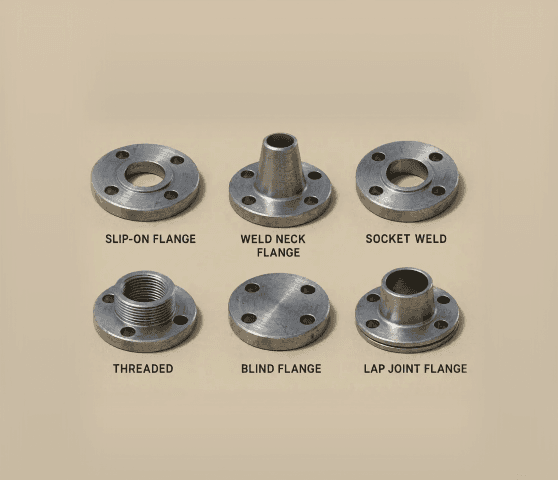
Weld Neck Flange (WN) is designed with a long tapered neck that distributes stress smoothly from the flange to the pipe. This design reduces fatigue and improves performance in high-pressure and high-temperature applications. Weld neck flanges are widely used in oil & gas, chemical processing, and power plants where joint integrity is critical.

Ring-Type Joint Flange (RTJ) is engineered for extreme service where leakage control is crucial. It uses a machined groove and a metallic ring gasket to achieve a high-integrity seal. RTJ flanges are common in refineries, high-pressure pipelines, and power systems where conventional gasket sealing may not be sufficient.

High-Strength Flanges for Critical Service

Weld Neck Flange (WN) is designed with a long tapered neck that distributes stress smoothly from the flange to the pipe. This design reduces fatigue and improves performance in high-pressure and high-temperature applications. Weld neck flanges are widely used in oil & gas, chemical processing, and power plants where joint integrity is critical.

Ring-Type Joint Flange (RTJ) is engineered for extreme service where leakage control is crucial. It uses a machined groove and a metallic ring gasket to achieve a high-integrity seal. RTJ flanges are common in refineries, high-pressure pipelines, and power systems where conventional gasket sealing may not be sufficient.

High-Strength Flanges for Critical Service

Weld Neck Flange (WN) is designed with a long tapered neck that distributes stress smoothly from the flange to the pipe. This design reduces fatigue and improves performance in high-pressure and high-temperature applications. Weld neck flanges are widely used in oil & gas, chemical processing, and power plants where joint integrity is critical.

Ring-Type Joint Flange (RTJ) is engineered for extreme service where leakage control is crucial. It uses a machined groove and a metallic ring gasket to achieve a high-integrity seal. RTJ flanges are common in refineries, high-pressure pipelines, and power systems where conventional gasket sealing may not be sufficient.

Installation-Friendly Flanges for General Service

Slip-On Flange (SO) slides over the pipe and is welded both on the inside and outside. It is faster and easier to install than a weld neck flange, making it a popular choice for low-pressure, moderate-temperature systems. Slip-on flanges are frequently used in utilities, HVAC, water lines, and non-critical industrial services.

Socket Weld Flange (SW) includes a socket recess where the pipe is inserted before welding. This configuration provides strong support and a leak-resistant joint, especially in small-diameter piping where high pressure is involved. Socket weld flanges are common in hydraulic systems, chemical lines, and gas services requiring compact yet robust connections.

Installation-Friendly Flanges for General Service

Slip-On Flange (SO) slides over the pipe and is welded both on the inside and outside. It is faster and easier to install than a weld neck flange, making it a popular choice for low-pressure, moderate-temperature systems. Slip-on flanges are frequently used in utilities, HVAC, water lines, and non-critical industrial services.

Socket Weld Flange (SW) includes a socket recess where the pipe is inserted before welding. This configuration provides strong support and a leak-resistant joint, especially in small-diameter piping where high pressure is involved. Socket weld flanges are common in hydraulic systems, chemical lines, and gas services requiring compact yet robust connections.

Installation-Friendly Flanges for General Service

Slip-On Flange (SO) slides over the pipe and is welded both on the inside and outside. It is faster and easier to install than a weld neck flange, making it a popular choice for low-pressure, moderate-temperature systems. Slip-on flanges are frequently used in utilities, HVAC, water lines, and non-critical industrial services.

Socket Weld Flange (SW) includes a socket recess where the pipe is inserted before welding. This configuration provides strong support and a leak-resistant joint, especially in small-diameter piping where high pressure is involved. Socket weld flanges are common in hydraulic systems, chemical lines, and gas services requiring compact yet robust connections.

Flanges Designed for Easy Maintenance and Disassembly

Blind Flange (BL) has no bore and is used to close the end of a pipe, valve, or pressure vessel opening. It is widely used during maintenance, hydrotesting, and future tie-in planning, and it can be applied across both high- and low-pressure systems depending on the rating and design.

Threaded Flange (TH) uses internal threads to screw onto threaded pipe. It is useful in situations where welding is not allowed or not practical, such as in hazardous environments or temporary piping. Threaded flanges are generally used for lower-pressure applications and smaller pipe sizes, including certain oil, gas, and water services.

Lap Joint Flange (LJ) consists of a loose backing flange paired with a stub end. This design allows easy rotation and alignment during installation and simplifies disassembly later. Lap joint flanges are often used where frequent dismantling is expected or where corrosion-resistant stub ends are required, making them common in chemical and marine environments.
Flanges Designed for Easy Maintenance and Disassembly

Blind Flange (BL) has no bore and is used to close the end of a pipe, valve, or pressure vessel opening. It is widely used during maintenance, hydrotesting, and future tie-in planning, and it can be applied across both high- and low-pressure systems depending on the rating and design.

Threaded Flange (TH) uses internal threads to screw onto threaded pipe. It is useful in situations where welding is not allowed or not practical, such as in hazardous environments or temporary piping. Threaded flanges are generally used for lower-pressure applications and smaller pipe sizes, including certain oil, gas, and water services.

Lap Joint Flange (LJ) consists of a loose backing flange paired with a stub end. This design allows easy rotation and alignment during installation and simplifies disassembly later. Lap joint flanges are often used where frequent dismantling is expected or where corrosion-resistant stub ends are required, making them common in chemical and marine environments.

Flanges Designed for Easy Maintenance and Disassembly

Blind Flange (BL) has no bore and is used to close the end of a pipe, valve, or pressure vessel opening. It is widely used during maintenance, hydrotesting, and future tie-in planning, and it can be applied across both high- and low-pressure systems depending on the rating and design.

Threaded Flange (TH) uses internal threads to screw onto threaded pipe. It is useful in situations where welding is not allowed or not practical, such as in hazardous environments or temporary piping. Threaded flanges are generally used for lower-pressure applications and smaller pipe sizes, including certain oil, gas, and water services.

Lap Joint Flange (LJ) consists of a loose backing flange paired with a stub end. This design allows easy rotation and alignment during installation and simplifies disassembly later. Lap joint flanges are often used where frequent dismantling is expected or where corrosion-resistant stub ends are required, making them common in chemical and marine environments.

Explore More Insights

Explore More Insights

Explore More Insights

Have a similar project in mind? Let us know!

(04)

aerial view of industrial factory

Have a similar project in mind? Let us know!

(04)

aerial view of industrial factory

Have a similar project in mind? Let us know!

(04)

aerial view of industrial factory
black and orange power tool

Take the Next Step Toward Engineering Excellence.

From 3D scanning to ongoing asset management - We deliver end-to-end solutions that reduce costs and improve operational efficiency

Contact Us

+91 84481 79046

+971 58556 6837

info@sixdengineering.com

Connect

© 2024 SIXD India. All rights reserved

black and orange power tool

Take the Next Step Toward Engineering Excellence.

From 3D scanning to ongoing asset management - We deliver end-to-end solutions that reduce costs and improve operational efficiency

© 2024 SIXD India. All rights reserved

black and orange power tool

Take the Next Step Toward Engineering Excellence.

From 3D scanning to ongoing asset management - We deliver end-to-end solutions that reduce costs and improve operational efficiency

© 2024 SIXD India. All rights reserved