Role of Drawings in Piping Engineering
In complex industrial projects, no single drawing type can address all engineering needs. Different documents are created to serve specific stakeholders—from designers and fabricators to construction teams and project managers. Among these, Isometric Drawings and GA Drawings form the backbone of piping documentation, each addressing a different level of detail and intent.
Role of Drawings in Piping Engineering
In complex industrial projects, no single drawing type can address all engineering needs. Different documents are created to serve specific stakeholders—from designers and fabricators to construction teams and project managers. Among these, Isometric Drawings and GA Drawings form the backbone of piping documentation, each addressing a different level of detail and intent.
Understanding Isometric Drawings
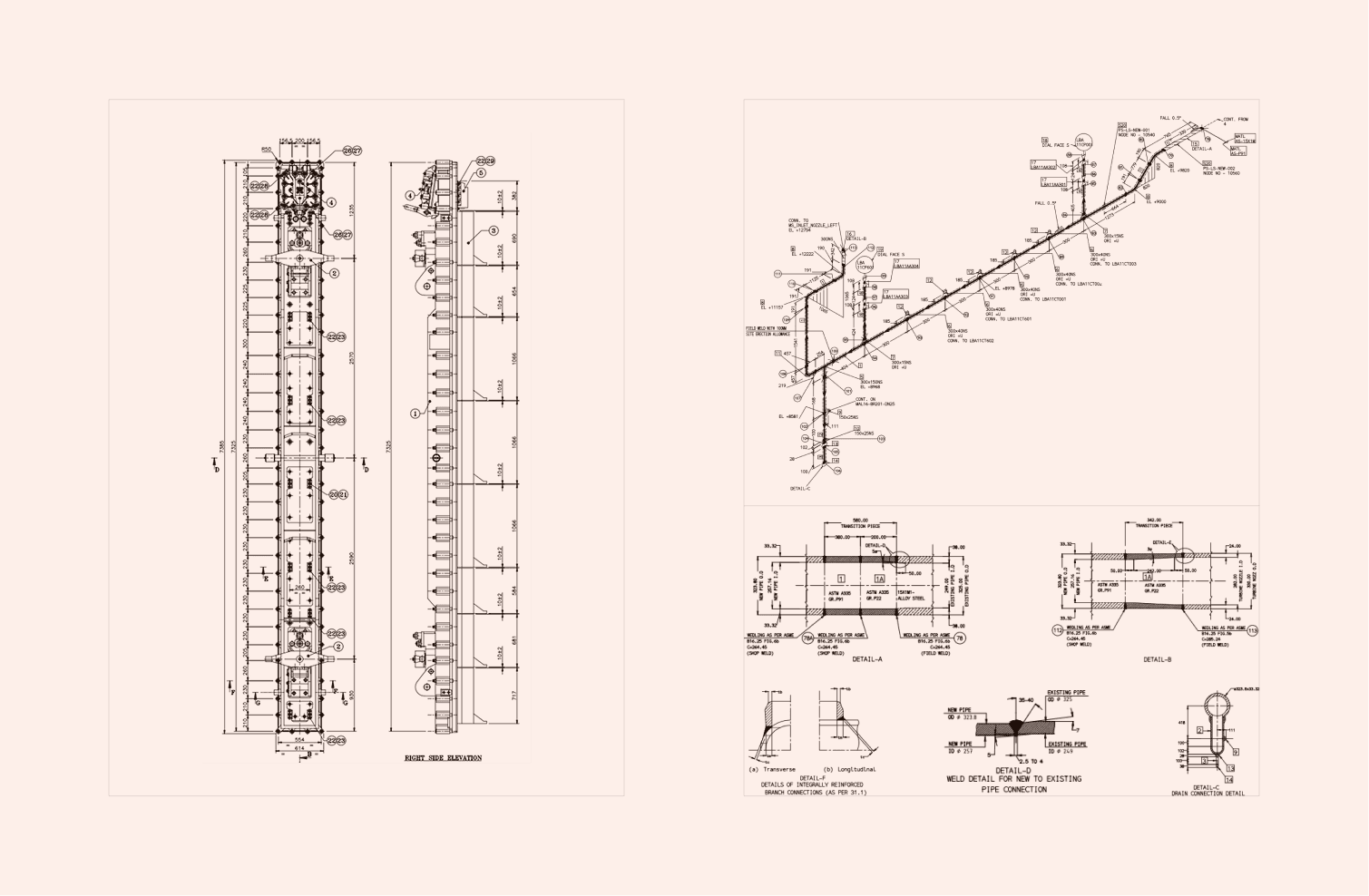
Isometric drawings provide a three-dimensional representation of individual piping lines. They are primarily used during fabrication and installation, offering detailed construction-level information required by piping designers, contractors, and site engineers.
Isometric drawings include pipe lengths, dimensions, material specifications, weld locations, support details, slopes, insulation requirements, and flow direction. Although they are not drawn to scale, they are dimensionally accurate and focused on execution. Their purpose is to ensure that each pipe spool can be fabricated and installed exactly as intended without ambiguity.
Understanding Isometric Drawings
Isometric drawings provide a three-dimensional representation of individual piping lines. They are primarily used during fabrication and installation, offering detailed construction-level information required by piping designers, contractors, and site engineers.
Isometric drawings include pipe lengths, dimensions, material specifications, weld locations, support details, slopes, insulation requirements, and flow direction. Although they are not drawn to scale, they are dimensionally accurate and focused on execution. Their purpose is to ensure that each pipe spool can be fabricated and installed exactly as intended without ambiguity.
Understanding General Arrangement (GA) Drawings
General Arrangement drawings present a two-dimensional layout of equipment, piping, and structures within a plant or facility. Rather than focusing on fabrication detail, GA drawings emphasize spatial relationships, clearances, and overall system integration.
GA drawings are commonly used during early design and coordination stages. They help engineers, project managers, and clients visualize equipment placement, piping corridors, elevations, and access paths. By showing how multiple disciplines intersect, GA drawings play a vital role in layout planning, safety compliance, and interdisciplinary coordination.
Understanding General Arrangement (GA) Drawings
General Arrangement drawings present a two-dimensional layout of equipment, piping, and structures within a plant or facility. Rather than focusing on fabrication detail, GA drawings emphasize spatial relationships, clearances, and overall system integration.
GA drawings are commonly used during early design and coordination stages. They help engineers, project managers, and clients visualize equipment placement, piping corridors, elevations, and access paths. By showing how multiple disciplines intersect, GA drawings play a vital role in layout planning, safety compliance, and interdisciplinary coordination.
Key Differences in Purpose and Usage
The primary difference between isometric and GA drawings lies in their scope and audience. Isometric drawings support construction and field execution by providing line-specific details, while GA drawings support planning and coordination by showing the broader layout of the facility. Isometrics answer how to build, whereas GA drawings answer how everything fits together.
Key Differences in Purpose and Usage
The primary difference between isometric and GA drawings lies in their scope and audience. Isometric drawings support construction and field execution by providing line-specific details, while GA drawings support planning and coordination by showing the broader layout of the facility. Isometrics answer how to build, whereas GA drawings answer how everything fits together.
Using Both Drawings Together Effectively
Successful piping projects rely on both drawing types working in tandem. GA drawings establish the layout framework and ensure coordination across systems, while isometric drawings translate that framework into buildable, install-ready information. When used together, they reduce clashes, improve clarity, and support smoother project execution from design through commissioning.
Using Both Drawings Together Effectively
Successful piping projects rely on both drawing types working in tandem. GA drawings establish the layout framework and ensure coordination across systems, while isometric drawings translate that framework into buildable, install-ready information. When used together, they reduce clashes, improve clarity, and support smoother project execution from design through commissioning.