Introduction
Industrial shutdowns and turnarounds leave little room for uncertainty. Every tie-in, replacement, access route, support modification, equipment lift, and prefabricated spool must fit into a plant that may have changed many times since its original drawings were issued.
That is why 3D laser scanning for shutdown planning is becoming a practical engineering step, not just a documentation activity. By capturing verified as-built conditions before the shutdown window begins, teams can plan work against reality, identify constraints early, and reduce avoidable surprises during execution.
For plants preparing revamps, retrofit packages, repair and maintenance work, or asset life extension, SixD's As-Built Engineering and Dimension Engineering workflows help turn complex site conditions into engineering-ready information.
Introduction
Industrial shutdowns and turnarounds leave little room for uncertainty. Every tie-in, replacement, access route, support modification, equipment lift, and prefabricated spool must fit into a plant that may have changed many times since its original drawings were issued.
That is why 3D laser scanning for shutdown planning is becoming a practical engineering step, not just a documentation activity. By capturing verified as-built conditions before the shutdown window begins, teams can plan work against reality, identify constraints early, and reduce avoidable surprises during execution.
For plants preparing revamps, retrofit packages, repair and maintenance work, or asset life extension, SixD's As-Built Engineering and Dimension Engineering workflows help turn complex site conditions into engineering-ready information.
Why Shutdown Planning Needs Verified As-Built Data
Shutdown scopes often depend on old drawings, manually marked updates, and field assumptions collected across years of maintenance. In brownfield plants, these records may not reflect rerouted lines, replaced supports, undocumented bypasses, civil changes, or equipment shifts.
During normal engineering, those gaps are inconvenient. During a shutdown, they become schedule risk.
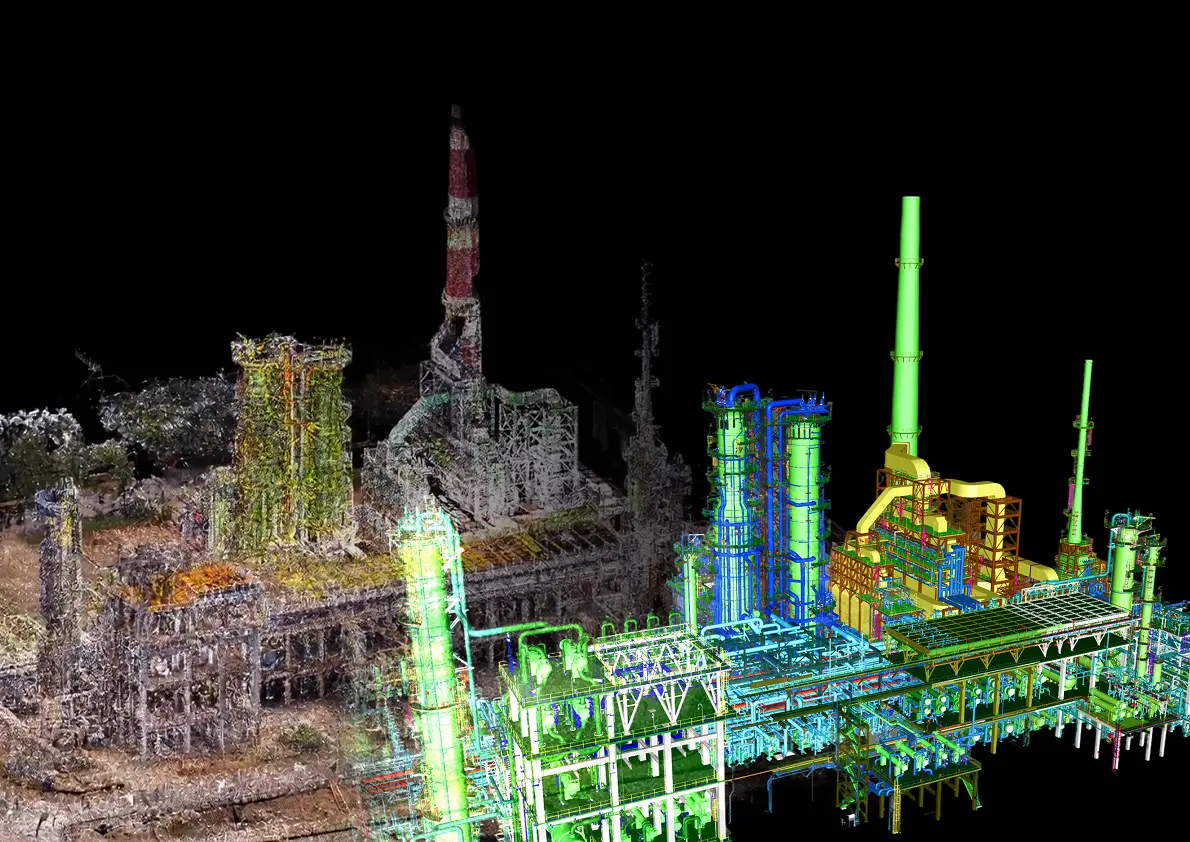
Laser scanning creates a measurable point-cloud record of the actual site before execution starts. Engineers can use this data to check clearances, validate tie-in locations, review access limitations, and coordinate fabrication around real plant geometry. This is especially useful in power, oil and gas, chemicals, metals, cement, and other process environments where congestion and safety constraints make repeat site checks difficult.
Why Shutdown Planning Needs Verified As-Built Data
Shutdown scopes often depend on old drawings, manually marked updates, and field assumptions collected across years of maintenance. In brownfield plants, these records may not reflect rerouted lines, replaced supports, undocumented bypasses, civil changes, or equipment shifts.
During normal engineering, those gaps are inconvenient. During a shutdown, they become schedule risk.
Laser scanning creates a measurable point-cloud record of the actual site before execution starts. Engineers can use this data to check clearances, validate tie-in locations, review access limitations, and coordinate fabrication around real plant geometry. This is especially useful in power, oil and gas, chemicals, metals, cement, and other process environments where congestion and safety constraints make repeat site checks difficult.
What to Capture Before the Shutdown Window
A useful shutdown scan should be planned around the work scope, not treated as a generic site survey. The scan plan should identify the areas where field reality can affect execution.
Tie-in and Interface Zones
Piping tie-ins, structural interfaces, duct connections, cable tray crossings, nozzle orientations, and equipment foundations should be captured with enough surrounding context to support design validation and installation sequencing.
Access and Constructability Constraints
Crane movement, scaffold zones, maintenance access, laydown areas, temporary supports, and removal paths can be reviewed more confidently when the team has a spatial record of actual obstructions.
Existing Supports and Adjacent Assets
Pipe supports, steel members, platforms, walkways, handrails, electrical routes, and nearby equipment often decide whether a modification can be executed as designed. Capturing these conditions early helps engineers prevent avoidable clashes.
Datum, Coordinates, and Control Points
Registered point clouds should align with the plant coordinate system or agreed project datums wherever possible. This makes the data easier to use across Plant 3D, E3D, Revit, Navisworks, CAD, and other engineering platforms.
What to Capture Before the Shutdown Window
A useful shutdown scan should be planned around the work scope, not treated as a generic site survey. The scan plan should identify the areas where field reality can affect execution.
Tie-in and Interface Zones
Piping tie-ins, structural interfaces, duct connections, cable tray crossings, nozzle orientations, and equipment foundations should be captured with enough surrounding context to support design validation and installation sequencing.
Access and Constructability Constraints
Crane movement, scaffold zones, maintenance access, laydown areas, temporary supports, and removal paths can be reviewed more confidently when the team has a spatial record of actual obstructions.
Existing Supports and Adjacent Assets
Pipe supports, steel members, platforms, walkways, handrails, electrical routes, and nearby equipment often decide whether a modification can be executed as designed. Capturing these conditions early helps engineers prevent avoidable clashes.
Datum, Coordinates, and Control Points
Registered point clouds should align with the plant coordinate system or agreed project datums wherever possible. This makes the data easier to use across Plant 3D, E3D, Revit, Navisworks, CAD, and other engineering platforms.
From Point Cloud to Shutdown Deliverables
The value of scanning comes from how the data is converted into decisions and deliverables. Depending on the project scope, point-cloud data can support:
As-built 3D models for congested areas
Tie-in verification and dimensional checks
Clash checks against proposed modifications
Piping isometrics and GA drawing validation
Equipment replacement studies
Support and access planning
Prefabrication checks before dispatch
Digital records for future maintenance and revamps
SixD has already covered broader point-cloud workflows in Brownfield Engineering with Point Clouds in P3D / E3D. For shutdown planning, the same principle becomes more urgent: if a decision will affect field execution, it should be validated against real conditions before the plant is offline.
From Point Cloud to Shutdown Deliverables
The value of scanning comes from how the data is converted into decisions and deliverables. Depending on the project scope, point-cloud data can support:
As-built 3D models for congested areas
Tie-in verification and dimensional checks
Clash checks against proposed modifications
Piping isometrics and GA drawing validation
Equipment replacement studies
Support and access planning
Prefabrication checks before dispatch
Digital records for future maintenance and revamps
SixD has already covered broader point-cloud workflows in Brownfield Engineering with Point Clouds in P3D / E3D. For shutdown planning, the same principle becomes more urgent: if a decision will affect field execution, it should be validated against real conditions before the plant is offline.
Connecting Shutdown Data to Digital Twin Readiness
Industry guidance around digital twins increasingly emphasizes interoperability, validation, and lifecycle information management. The NIST Digital Twins for Advanced Manufacturing program focuses on definitions, essential elements, standards alignment, and validation for digital twin adoption. The ISO 19650 series also frames asset information as a lifecycle discipline, not simply a 3D model handover.
For industrial owners, this means shutdown scanning should not be treated as one-time survey data that disappears after the project. A registered point cloud, verified model, and structured asset documentation can become part of a longer digital foundation for future inspections, revamps, maintenance planning, and Digital Intelligence initiatives.
AVEVA Point Cloud Manager describes point-cloud data as useful for brownfield, greenfield, maintenance, modification, turnaround, and retrofit planning. The practical takeaway is clear: shutdown data creates more value when it is accessible to engineering and operations teams beyond a single outage.
Connecting Shutdown Data to Digital Twin Readiness
Industry guidance around digital twins increasingly emphasizes interoperability, validation, and lifecycle information management. The NIST Digital Twins for Advanced Manufacturing program focuses on definitions, essential elements, standards alignment, and validation for digital twin adoption. The ISO 19650 series also frames asset information as a lifecycle discipline, not simply a 3D model handover.
For industrial owners, this means shutdown scanning should not be treated as one-time survey data that disappears after the project. A registered point cloud, verified model, and structured asset documentation can become part of a longer digital foundation for future inspections, revamps, maintenance planning, and Digital Intelligence initiatives.
AVEVA Point Cloud Manager describes point-cloud data as useful for brownfield, greenfield, maintenance, modification, turnaround, and retrofit planning. The practical takeaway is clear: shutdown data creates more value when it is accessible to engineering and operations teams beyond a single outage.
Common Mistakes to Avoid
Scanning Too Late
If scanning begins only after engineering decisions are already frozen, the data may expose clashes when there is little time left to redesign. Pre-shutdown scanning should support early engineering, not only final verification.
Capturing Data Without Engineering Context
A point cloud is not a shutdown plan by itself. The scan must be connected to the work package, engineering questions, and deliverables required by site teams.
Ignoring Field Validation
Critical dimensions, control points, and high-risk interfaces should be reviewed through a disciplined QA process. This keeps the model reliable when it is used for fabrication, fit-up, and constructability planning.
Treating the Output as a Static Archive
The best shutdown data continues to create value after the turnaround ends. Updated models, tagged information, revised drawings, and structured records can support the next outage or brownfield upgrade.
Common Mistakes to Avoid
Scanning Too Late
If scanning begins only after engineering decisions are already frozen, the data may expose clashes when there is little time left to redesign. Pre-shutdown scanning should support early engineering, not only final verification.
Capturing Data Without Engineering Context
A point cloud is not a shutdown plan by itself. The scan must be connected to the work package, engineering questions, and deliverables required by site teams.
Ignoring Field Validation
Critical dimensions, control points, and high-risk interfaces should be reviewed through a disciplined QA process. This keeps the model reliable when it is used for fabrication, fit-up, and constructability planning.
Treating the Output as a Static Archive
The best shutdown data continues to create value after the turnaround ends. Updated models, tagged information, revised drawings, and structured records can support the next outage or brownfield upgrade.
Building Confidence Before the Plant Stops
Shutdown execution is measured in hours and days, but the quality of that execution is shaped long before the plant stops. Accurate as-built laser scanning gives engineering, maintenance, and project teams a common view of the real site before work reaches the critical path.
With the right capture plan, modeling workflow, and engineering review, 3D laser scanning helps reduce uncertainty, improve coordination, and support safer, more predictable shutdown outcomes.
If your team is planning a shutdown, revamp, retrofit, or brownfield modification, SixD Engineering can help convert complex plant reality into verified engineering intelligence.
Building Confidence Before the Plant Stops
Shutdown execution is measured in hours and days, but the quality of that execution is shaped long before the plant stops. Accurate as-built laser scanning gives engineering, maintenance, and project teams a common view of the real site before work reaches the critical path.
With the right capture plan, modeling workflow, and engineering review, 3D laser scanning helps reduce uncertainty, improve coordination, and support safer, more predictable shutdown outcomes.
If your team is planning a shutdown, revamp, retrofit, or brownfield modification, SixD Engineering can help convert complex plant reality into verified engineering intelligence.